 Skip to content

What Is an Alarm Receiving Centre (ARC) and Why It Matters
Quick facts
- An Alarm Receiving Centre (ARC) is a staffed control room that receives, verifies, and responds to signals from monitored alarm systems around the clock.
- A 24 hour Alarm Receiving Centre Ireland operates every day of the year, with trained operators verifying alerts and contacting keyholders, Gardaí, or emergency services.
- Certified ARCs in Ireland typically comply with EN 50518 or BS 5979 Category II standards and hold a Private Security Authority (PSA) licence.
- Monitored alarms connected to an ARC help ensure a faster, verified response compared with unmonitored systems that rely on neighbours or passers-by noticing an alert.
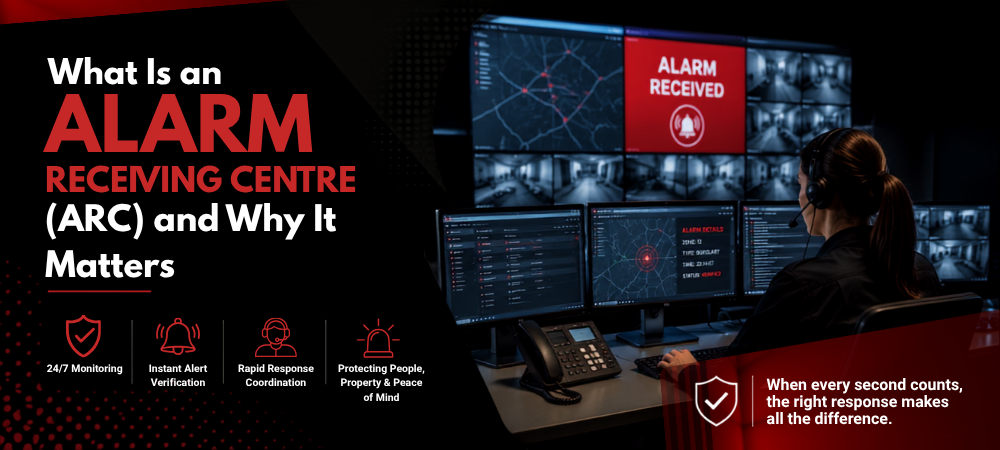
An Alarm Receiving Centre (ARC) is the control room that sits behind every professionally monitored alarm system. When a sensor is triggered at a home or business, the signal doesn’t just sound a siren locally — it travels to a 24 hour Alarm Receiving Centre in Ireland, where a trained operator checks the alert and decides what happens next.
This matters because an alarm that nobody hears, or that a neighbour ignores, does very little to protect a property. A certified ARC turns a simple beep into a verified, actioned event — which is the entire point of paying for 24/7 alarm monitoring Ireland in the first place.
What Is an Alarm Receiving Centre (ARC), Exactly?
An ARC is a secure, staffed facility that receives electronic signals from intruder alarms, fire alarms, and CCTV systems installed at homes and businesses. Operators work in shifts so the centre never closes, which is why the service is often described as professional alarm monitoring Ireland relies on around the clock.
Most ARCs in Ireland and the UK are built to one of two recognised standards:
- EN 50518 — the European standard for alarm receiving centres, covering building security, staffing, and equipment redundancy.
- BS 5979 Category II — a British standard still widely referenced for ARC construction and operating procedures.
A genuinely certified alarm monitoring Ireland provider will hold third-party accreditation against one of these standards, plus a licence from the Private Security Authority (PSA), which regulates the security industry in Ireland.
How an Alarm Signal Reaches the ARC
The path from a triggered sensor to a human response usually follows the same pattern:
- A sensor (door contact, motion detector, smoke detector, or CCTV analytics) detects an event.
- The alarm panel sends a signal over a phone line, GPRS, or IP connection to the ARC.
- An operator at the security monitoring services Ireland provider receives the signal on screen, along with the property’s site history and emergency contacts./
- The operator follows an agreed response plan — which might include calling keyholders, checking live CCTV, contacting the Gardaí, or dispatching a mobile patrol.
How 24/7 Alarm Monitoring Ireland Works Behind the Scenes
A genuine 24 hour Alarm Receiving Centre Ireland doesn’t just have someone on a night shift. Reputable centres run with:
- Redundant power and connectivity, so the centre stays online during outages.
- Backup ARC sites, so monitoring continues even if the primary building is affected.
- Trained, vetted operators, often screened to industry security-clearance standards.
- Documented response protocols for every client, agreed in advance.
This infrastructure is what separates certified alarm monitoring Ireland companies from a basic app notification that simply pings a phone and hopes someone is awake to see it.
Types of Monitored Security Systems Ireland Providers Support
Home Alarm Monitoring Ireland
For residential customers, home alarm monitoring Ireland typically covers intruder detection, and often smoke or carbon monoxide alerts too. When a sensor triggers, the ARC verifies the alert — often via a phone call to the homeowner — before deciding whether to escalate.
Commercial Alarm Monitoring Ireland
Businesses have different needs. Commercial alarm monitoring Ireland services often combine intruder detection with access control, fire panel integration, and out-of-hours lone-worker alerts, since commercial sites are frequently unoccupied for long stretches and hold more valuable stock or equipment.
CCTV and Alarm Monitoring Ireland Combined
Many providers now offer CCTV and alarm monitoring Ireland as a single service. When an intruder alarm triggers, the operator can pull up live camera footage before deciding on a response — known as video verification. This reduces false-alarm callouts and gives the Gardaí more useful information if attendance is genuinely required.
What Happens During Intruder Alarm Monitoring Ireland Response
Intruder alarm monitoring Ireland follows a fairly standard escalation sequence once a signal is confirmed as a genuine alert:
- The operator attempts to contact the property's designated keyholders.
- If there's no response, or the situation looks serious, the operator may escalate to Garda notification.
- Some alarm response services Ireland providers also offer mobile patrol response, sending a licensed security officer to the site.
- Every action is logged and time-stamped, giving the property owner a clear audit trail after the event.
Response times vary by provider and by the nature of the alert, but the value of a monitored system is that someone is always checking — rather than relying on chance.
Benefits of Monitored Alarms for Homes in Ireland
The benefits of monitored alarms for homes in Ireland go beyond simply having a louder siren. Key advantages include:
- Faster, verified response — an ARC operator checks the alert instead of leaving it to a hopeful neighbour.
- Reduced false-alarm callouts — video verification and operator checks filter out accidental triggers before anyone is dispatched.
- Insurance benefits — many insurers offer reduced premiums for homes with a certified monitored alarm, since risk is lower.
- Protection while away — holidaymakers and shift workers get the same level of cover whether they're home or not.
- Peace of mind for family — relatives monitoring an elderly parent's home can be reassured that alerts are actively managed, not just logged.
How to Choose the Best Alarm Monitoring Company Ireland Has to Offer
Not every provider advertising “monitoring” actually operates a certified ARC. When comparing the best alarm monitoring company Ireland options, check for:
- PSA licensing — confirm the company is registered with the Private Security Authority.
- ARC accreditation — ask which standard (EN 50518 or BS 5979 Cat II) the monitoring centre is certified against, and by whom.
- Redundancy — find out whether there's a backup ARC if the primary site loses power or connectivity.
- Response protocol clarity — you should be told exactly what happens, in what order, when your alarm triggers.
- Transparent contracts — clear terms on monitoring fees, contract length, and equipment ownership.
- Local response capability — ask whether the provider offers mobile patrol or keyholder response in your area, not just a phone call to a call centre.
Frequently Asked Questions
An ARC is a staffed control room that receives signals from monitored alarm systems, verifies whether an alert is genuine, and follows an agreed response plan — such as contacting keyholders or the Gardaí.
It isn't legally required, but 24/7 alarm monitoring Ireland services significantly increase the chance that a genuine break-in is acted on quickly, rather than relying on a loud siren alone.
Look for accreditation against EN 50518 or BS 5979 Category II, plus a current licence from the Private Security Authority (PSA).
Many insurers offer discounts for homes with a certified monitored alarm system, though the exact reduction depends on the insurer and policy.
Home alarm monitoring Ireland usually focuses on intruder and fire detection for occupied residential properties, while commercial alarm monitoring Ireland often adds access control, out-of-hours cover, and integration with CCTV for larger or unoccupied sites.
The Bottom Line
An Alarm Receiving Centre is the part of a security system most people never see — but it’s the part that actually decides what happens when an alarm goes off. Whether you’re comparing home alarm monitoring Ireland options or looking for commercial alarm monitoring Ireland for a business premises, the same rule applies: check that the provider operates a certified, properly staffed ARC, not just an app that sends a notification and hopes for the best.
If you’re currently relying on an unmonitored system, it’s worth asking your installer whether your alarm is connected to a certified 24 hour Alarm Receiving Centre in Ireland — and if not, what it would take to upgrade.
SEND US MESSAGE
RECENT POSTS
A practical guide for data centre operators, facility managers and IT decision-makers across the UK and Ireland...

A practical, professional guide for event organisers, venue managers and corporate/festival/ conference planners across Ireland and the UK...
Every year, thousands of Irish homeowners lock up, head for the airport, and spend the first evening of their holiday...
Personal alarms for seniors let an older person call for help at the press of a button, day or night,...
