 Skip to content

Is Your Business CCTV GDPR Compliant? An Irish Guide
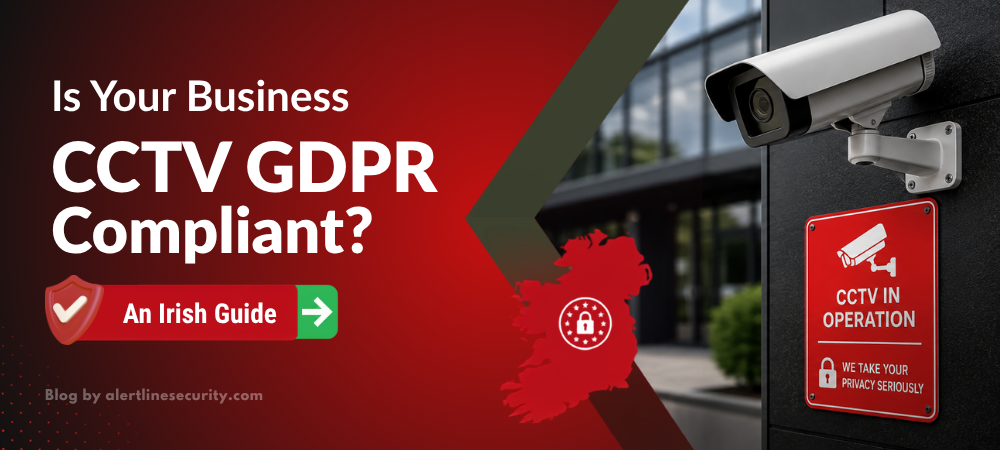
Most Irish businesses install cameras for an obvious reason: to protect people, premises and property. What many owners overlook is that the moment a camera records a recognisable face, it is processing personal data — and that pulls the entire system under data protection law. CCTV GDPR compliance in Ireland is not an optional extra reserved for large corporations. It applies to the corner shop, the hotel, the warehouse and the office alike. This guide walks through the business CCTV rules in Ireland, what the Data Protection Commission (DPC) expects, and the practical steps that keep your system on the right side of the law.
Why CCTV Falls Under GDPR
Any recognisable image of a person is personal data. Once your cameras capture identifiable individuals — staff, customers or passers-by — your footage is governed by the General Data Protection Regulation (GDPR) and the Data Protection Act 2018. That makes your business a data controller, with full legal responsibility for how that footage is collected, stored, accessed and deleted
The stakes are real. Under GDPR, the maximum penalty for serious non-compliance is up to €20 million or 4% of global annual turnover, whichever is higher. The DPC has shown it will act: in recent years it has fined organisations for covertly monitoring staff and for holding footage far longer than necessary. Understanding GDPR CCTV Ireland requirements is therefore a matter of risk management, not box-ticking.
Do You Have a Lawful Basis? The Six Questions to Ask
Before a single camera goes live, the DPC expects you to be able to answer a clear set of questions. Working through them is the foundation of any defensible CCTV data protection in Ireland setup:
- Purpose: Do you have a clearly defined reason for installing CCTV, such as preventing theft or protecting staff safety?
- Lawfulness: What is your legal basis under Article 6 GDPR? For most businesses this is legitimate interest; occasionally it is a legal obligation. Consent is rarely workable for general surveillance.
- Necessity: Can you demonstrate that CCTV is genuinely needed, rather than installed simply because it is available?
- Proportionality: Is the level of monitoring balanced against people's reasonable expectation of privacy? Cameras in toilets or break rooms almost never pass this test.
- Security: How will recordings be stored safely and protected from unauthorised access?
- Retention and transparency: How long will footage be kept, and how will you inform people they are being recorded?
If you cannot answer these confidently, you are exposed. Documenting your reasoning — ideally in a written CCTV policy — is one of the most important business CCTV GDPR compliance steps you can take.
Signage and Transparency: The Most Visible Rule
People have a right to know when they are being recorded. Clear, well-lit signage is a core CCTV legal requirement in Ireland, and it is the area regulators notice first because it is literally on display. A vague sign reading “Smile, you’re on camera” is not enough.
Effective CCTV signage should:
- State that CCTV is in operation and the purpose of the monitoring (for example, security and crime prevention).
- Identify the data controller — the business responsible for the system.
- Provide a contact point for anyone who wishes to query the recording or exercise their rights.
- Be supported by a fuller privacy notice that explains how footage is collected, stored, used and how long it is kept.
Signs should be placed prominently at entrances and within monitored areas, so individuals are informed before they are captured rather than after.
Retention and Secure Storage
A guiding principle of GDPR is that personal data should not be kept for longer than necessary. For routine business security, around 30 days is widely treated as a reasonable benchmark, and many systems retain footage for 14 to 30 days depending on the site and its risk profile. Holding recordings “just in case” indefinitely is a clear compliance red flag.
If you need to keep footage longer — for example, because it captures an incident under investigation — you must be able to justify it, document the reason and store it securely until the matter concludes. Beyond retention periods, storage itself must be protected: restrict access to authorised personnel, keep a log of who views footage, and use encryption where recordings can be accessed remotely. These measures sit at the heart of credible CCTV data protection in Ireland.
DPIAs, Covert Surveillance and Employee Monitoring
Higher-risk monitoring demands extra care. A Data Protection Impact Assessment (DPIA) should be carried out before deploying CCTV in sensitive contexts — for instance, where children are present, where employees are monitored, or where advanced features such as facial recognition are used. The DPIA forces you to weigh the benefits against the privacy intrusion and to record that analysis.
Employee monitoring is a particular flashpoint. The DPC has penalised organisations for covertly recording staff and for using cameras to track productivity — a purpose unrelated to legitimate security. Covert surveillance is only justifiable in narrow circumstances, must be focused and short in duration, and requires a DPIA beforehand. Clear workplace policies, ideally developed with staff or their representatives, help maintain both trust and compliance under the business CCTV rules in Ireland.
Access Requests and Working With Security Providers
Anyone recorded on your system has the right to request a copy of their own footage through a Subject Access Request (SAR). You normally have one month to respond. When you release footage, you must obscure other identifiable people in the frame to protect their rights. If the footage has already been deleted under your retention policy by the time the request arrives, you simply confirm it no longer exists.
If a third party installs or monitors your cameras, that company is acting as a data processor on your behalf. You remain the controller and stay legally accountable. A written contract should set out what the provider may do with the data, the security standards they must meet, and how access is controlled. Asking a prospective installer about their GDPR practices before you sign is a simple way to protect yourself.
Your Quick Compliance Checklist
Use this as a starting point to pressure-test your current setup:
- Audit every camera: map locations, purpose and retention schedule.
- Confirm and document your lawful basis under Article 6.
- Update signage so it names the controller, purpose and a contact point.
- Publish a clear CCTV privacy notice and a written internal policy.
- Set retention limits, secure storage, and an access log.
- Complete a DPIA for any high-risk or employee monitoring.
- Put a written contract in place with any security provider.
- Review the whole system at least once a year as technology and risks evolve.
Staying Compliant — and Building Trust
CCTV is one of the most effective security investments a business can make, but it is also a data-processing system that carries real obligations. The good news is that compliance is largely about discipline rather than expense: a clear purpose, honest signage, justified retention, secure storage and a documented policy will put most Irish businesses in a strong position. Getting CCTV GDPR compliance in Ireland right protects you from fines, but it does something just as valuable — it shows staff and customers that you take their privacy seriously.
If you are unsure whether your current system meets these standards, the safest next step is to review it against the checklist above and, where monitoring is sensitive or large-scale, seek tailored advice. Audit your CCTV today — a short review now is far cheaper than a regulatory investigation later.
SEND US MESSAGE
RECENT POSTS
A practical guide for data centre operators, facility managers and IT decision-makers across the UK and Ireland...

A practical, professional guide for event organisers, venue managers and corporate/festival/ conference planners across Ireland and the UK...
Every year, thousands of Irish homeowners lock up, head for the airport, and spend the first evening of their holiday...

Personal alarms for seniors let an older person call for help at the press of a button, day or night,...
